
Paranoia and absolute power: Ali Khamenei led Iran with supreme self-confidence
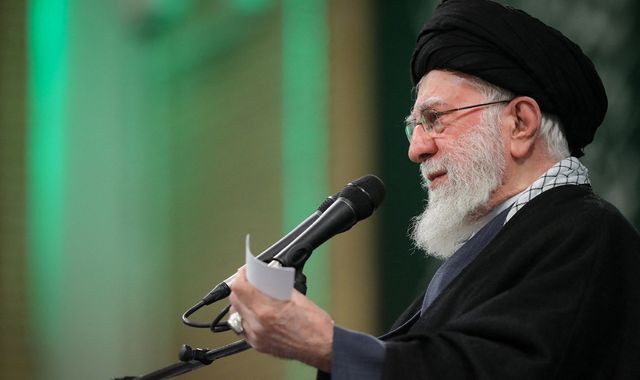
Ayatollah Ali Khamenei ruled Iran for decades, fuelled by paranoia, absolute power and a belief in his own divine destiny.
He was the country's supreme leader, and he led with supreme self-confidence.
Khamenei was killed in US-Israel strikes on Iran on Saturday.
In announcing his death, Donald Trump called him "one of the most evil people in history" and urged Iranians "to take back their Country" and bring about regime change.
Iranian state media confirmed the 86-year-old's death but did not specify the cause.
Khamenei's rise to power
Khamenei was 50 years old when he was appointed as successor to Iran's first supreme leader, Ruhollah Khomeini.
The role he inherited was already endowed with enormous control, yet Khamenei added to it. The Iran he moulded revolved entirely around him.
Iran latest: Supreme leader Ayatollah Khamenei is dead
His regime faced many protests and was deeply unpopular with many Iranians. But the network of secret informants and guards that he created, overseen by the loyal Revolutionary Guard, held sway.
Most were too scared to protest, not least because they saw what happened to those who did openly express dissent.
In 2022, for instance, protests sprang up after the death, in police custody, of Mahsa Amini, the young woman accused of violating strict dress codes.
Khamenei and his faithful security forces were violent in their response.
More than 7,000 people were killed during the unrest, according to one human rights group. Nearly 53,000 protesters were believed to have been arrested.
Yet Khamenei was as defiant as he was indifferent, saying at the time "enemies" who thought they could "uproot the tree of the Islamic Republic" were "completely wrong".
He was driven by a dogmatic certainty that there was a path that needed to be followed, regardless of the consequences.
A key part in the 1979 revolution
Khamenei was born and raised in Mashhad, home to Iran's holiest shrine. His childhood saw him receive a religious education that he combined with an interest in politics.
Khamenei joined a religious opposition movement aimed at overthrowing Iran's monarchy, many years before the 1979 revolution that would eventually usher in the Islamic Republic.
He played a key part in that revolution and was a trusted, close confidant of Ayatollah Khomeini, earning a succession of significant roles. In 1981, Khamenei survived an assassination attempt that cost him the use of his right arm. Later that year, he was elected president with 97% of the vote - the previous president had been assassinated.
Khamenei served two terms as president before assuming the role of supreme leader when Khomeini died.
He was not a clear-cut choice, lacking the religious credentials that the constitution demanded, but in the end, the constitution was changed and, despite his own protestations of unworthiness, Khamenei took on the position.
A proposal to share power among a council, in order to maintain social unity, was shelved.
A cult of personality
His decades in power were characterised by a cult of personality, which Khamenei absolutely encouraged, and by his ability to quickly load all of Iran's institutions with leaders who were absolutely loyal to him.
His decrees were absolute; loyalty was expected. Iran's economy meandered and declined, particularly as he diverted billions and billions of dollars towards developing a nuclear programme that placed him at odds with so many Western powers, and which led to punitive sanctions that hobbled his nation.
A nuclear deal was signed in 2015 to limit Iran's activities in return for the lifting of trade restrictions, but Iranians saw no improvement, again taking to the streets in frustration at life under sanctions, with now familiar personal grievances against their leader.
Read more:
Khamenei admits thousands died in Iran protests
Analysis: How the Iran uprising unfolded
The deal eventually unravelled under President Trump, leaving Iran's economy isolated and the supreme leader furious.
"Trump will die and his body will turn into ashes and food for worms and ants, but the Islamic Republic will continue to stand", Khamenei said of Trump with a typical rhetorical flourish. America was the "Great Satan" in Khamenei's mind.
Israel was the "Little Satan", the country he vowed to destroy.
The supreme leader's later years of life saw Iran form an Axis of Resistance, united against Israeli and American influence in the Middle East.
Under his watch, Iran armed Russia with Iranian-made drones to fire at Ukraine, and Tehran bankrolled its two main proxies in the region, Hezbollah and Hamas, to target its sworn enemy, Israel.
Khamenei supported Hamas's 7 October attacks and encouraged and bankrolled Hezbollah's subsequent assaults from Lebanon.
???? Follow Trump100 on your podcast app ????
He backed the Houthis in Yemen, as well as other insurgent groups across the region and then launched his own missile strikes on Israel. But when Israel responded, with a precision and determination that came from years of planning, Khamenei suddenly seemed to have no answers.
The furious rhetoric was still there, but the air of invulnerability seemed to have slipped away. The supreme leader's supreme self-confidence no longer seemed so assured.
The world has changed profoundly since Ali Khamenei took power. How, when and by whom he is replaced is a question of huge significance: for Iran, the Middle East and across the globe.